Bhutan
Paro, Thimphu, Punakha and Bhutan’s sacred valleys ——— brought alive through dzongs, monasteries, mountain drives and deeply immersive cultural journeys.

Paro Valley
Bhutan arrives like a rumour made real. The flight alone — a descent through Himalayan peaks so close you feel you could reach out and touch the pine forests — tells you that you are entering somewhere that has chosen, deliberately and wisely, to remain itself.
Paro Valley unfolds below in a patchwork of rice fields and farmhouses, the ancient dzong guarding the river as it has for centuries. Above it all, clinging to a cliff face with the calm certainty of something that was always meant to be exactly there, Tiger’s Nest waits.
The walk up is the point. Prayer flags thread through the air around you, the valley dropping away below with each turn of the path, until you arrive breathless — not only from altitude — at a monastery that seems less built than conjured.
Amankora-style travel here means moving between valley lodges with unhurried intention, each stay a different angle on a kingdom that measures its wealth not in figures but in happiness.
Arrive reverent. Leave changed.

Paro, Thimphu, Punakha
Bhutan moves at a pace that feels, at first, like slowness — and reveals itself, gradually, as wisdom. There is no urgency here, no sense that the next place will be better than the one you are standing in. The kingdom simply asks you to be present, and then gives you every reason to comply.
Paro offers the valley and the climb — Tiger’s Nest earned rather than simply visited, the effort becoming part of what makes it sacred. Thimphu, the world’s only capital without a traffic light, conducts its affairs with a quiet confidence, its weekend market a gentle collision of monks, farmers and city dwellers that tells you everything about how this country holds itself together.
Then Punakha, where the Pho Chhu and Mo Chhu rivers meet below a dzong so perfectly placed it looks painted into its own landscape.
Three valleys. Three distinct moods. One coherent, carefully tended kingdom that asks only one thing of its visitors.
Pay attention.

Dzongs & Monasteries
There is an architecture of intention in Bhutan that you feel before you understand it. The dzongs rise from river confluences and ridge lines not merely as fortresses or administrative centres but as anchors — places where the sacred and the civic have always been understood as the same thing.
You move through valleys where the human scale feels restored. Farmhouses painted with protective symbols. Monks crossing a courtyard in a wash of saffron. A festival drum heard from across a hillside before the source comes into view — and then the dancers appear, masked and magnificent, performing stories that have kept communities whole for centuries.
The luxury in Bhutan is contextual — small lodges with large windows framing monastery views, farm-to-table dinners where the vegetables were growing this morning, a hot stone bath drawn at dusk while mist fills the valley below.
Nothing here competes for your attention. Everything simply offers itself — the landscape, the culture, the silence — with a generosity that feels almost personal.
Come still. Leave fuller.

Dochula Pass
The road climbs through blue pine and rhododendron, each switchback lifting you a little further from the valley floor and a little closer to something that feels, as you rise, increasingly like revelation. At Dochula, the clouds sometimes part without warning — and when they do, the entire eastern Himalayan range appears at once, one hundred and eight chortens standing in quiet rows in the foreground as if placed there specifically to give the eye somewhere to rest before the mountains overwhelm it.
The drive itself is the experience. Bhutan’s roads move through landscapes that demand to be taken slowly — a dzong appearing around a bend, a waterfall threading down a cliff face, a yak regarding you with the magnificent indifference of a creature that has never once doubted its place in the world.
At the pass, a monastery sits in the mist. Prayer flags run in long lines between the pines, carrying their whispered intentions up into the cold Himalayan air.
Some views change you quietly.
This is one of them.

Festival Journeys
To witness a Bhutanese tsechu is to understand something about joy that is difficult to articulate afterwards — not because the experience is beyond words, but because the words available in most languages were not built to carry this particular weight of colour, devotion and communal celebration.
The masked dancers emerge into the courtyard of an ancient dzong, their costumes a controlled riot of silk and brocade, their movements older than anyone present can trace. These are not performances staged for visitors. They are acts of merit, retelling sacred stories that have held communities together across centuries of mountain winters and harvest seasons.
Getting this right requires planning months in advance — festival dates shift with the lunar calendar, the finest viewpoints fill quickly, and the difference between witnessing a tsechu from the crowd and experiencing it with context and proximity is the difference between watching and understanding.
This is what priority planning gives you — not just access, but meaning.
The festival was always extraordinary. Arriving prepared makes it yours.
Happiness Kingdom
The phrase Gross National Happiness is easy to dismiss as policy language until you spend a few days in Bhutan and realise it describes something you can actually feel — in the unhurried way a monk holds a conversation, in the care with which a farmhouse has been painted, in the simple fact that the forests are protected not as an economic calculation but as an article of faith.
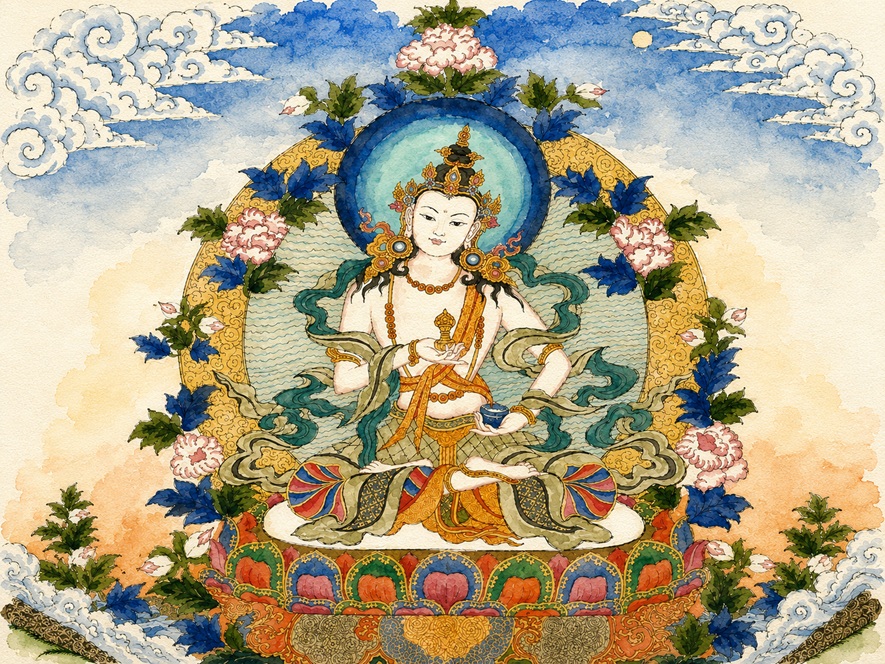
Bhutanese craft carries this same intentionality. The thangkas, the woven textiles, the hand-hammered silverwork — each piece is the product of a tradition that sees making beautiful things as inseparable from living a meaningful life. In the craft workshops of Thimphu and Paro, you watch this understanding at work, and it is quietly humbling.
The elevated comfort here — the lodge fires lit before you arrive, the farm dinners, the guides who speak about their country with genuine pride rather than rehearsed enthusiasm — feels like an extension of the same philosophy.
Bhutan does not perform happiness.
It practises it.